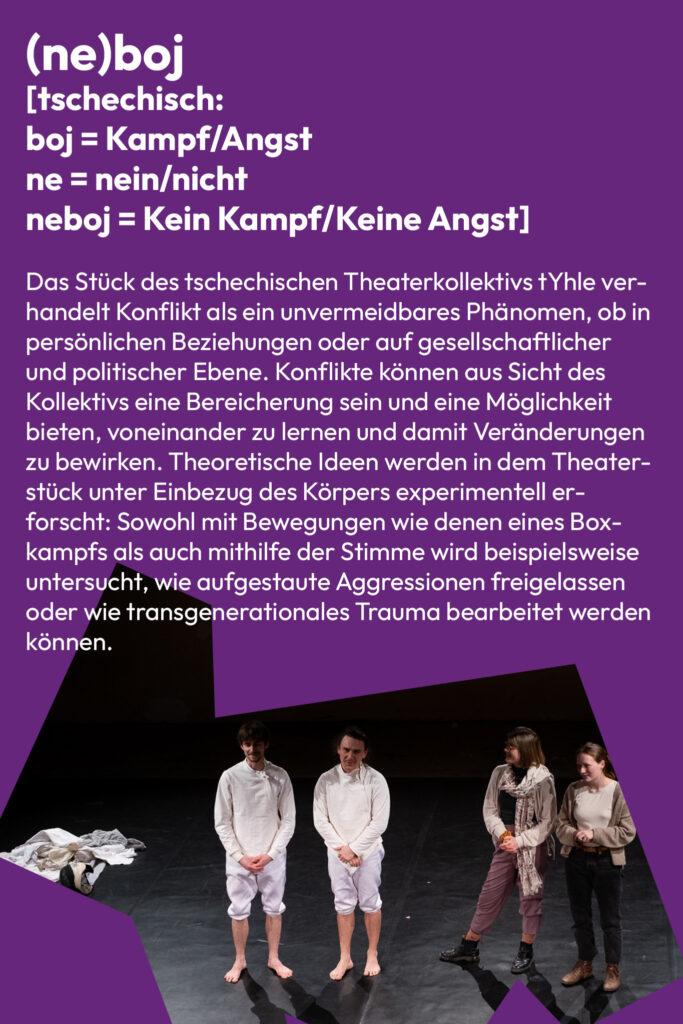
Konflikt als Chance – in den Augen vieler Menschen verbindet dieses Statement zwei Phänomene miteinander, die auf den ersten Blick nicht so recht zusammenpassen wollen. Genau dieser ambiguen Vielschichtigkeit von Konflikt nähert sich das Performancestück (ne)boj des tschechischen Theaterkollektivs tYhle. Auch an der ConflictA wird der Konfliktbegriff aus verschiedenen Perspektiven verhandelt – darunter auch die der konstruktiven Konflikttransformation1 und des positiven Friedensverständnisses2, die Konflikt als Gelegenheit für Wandel (um-)definieren.
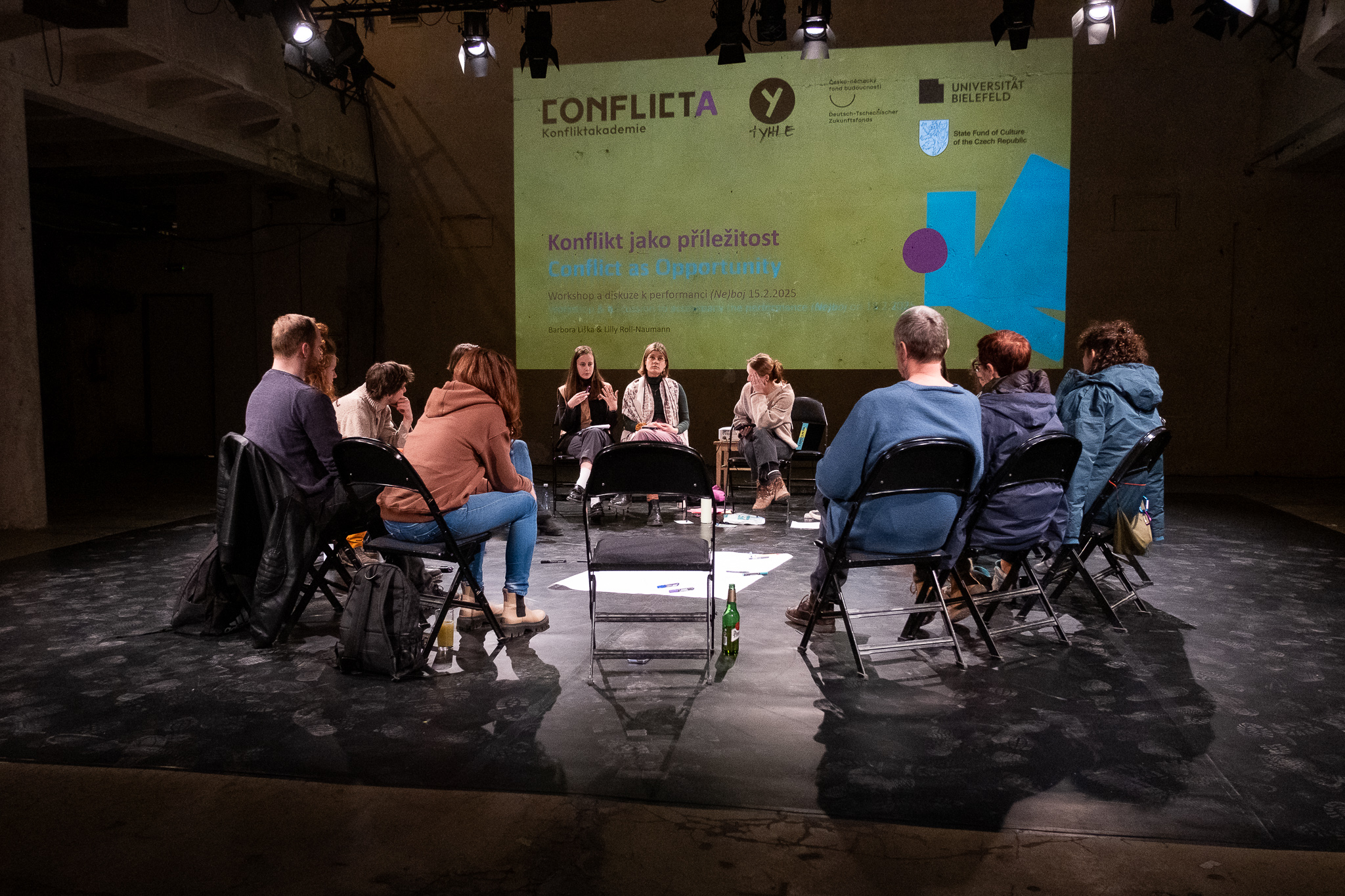
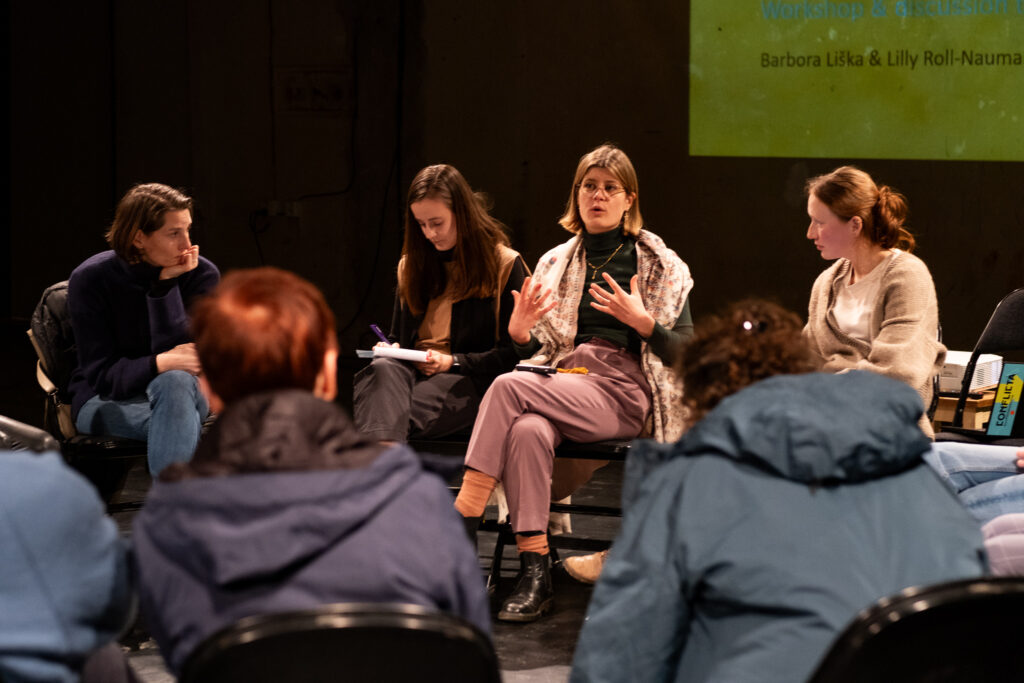
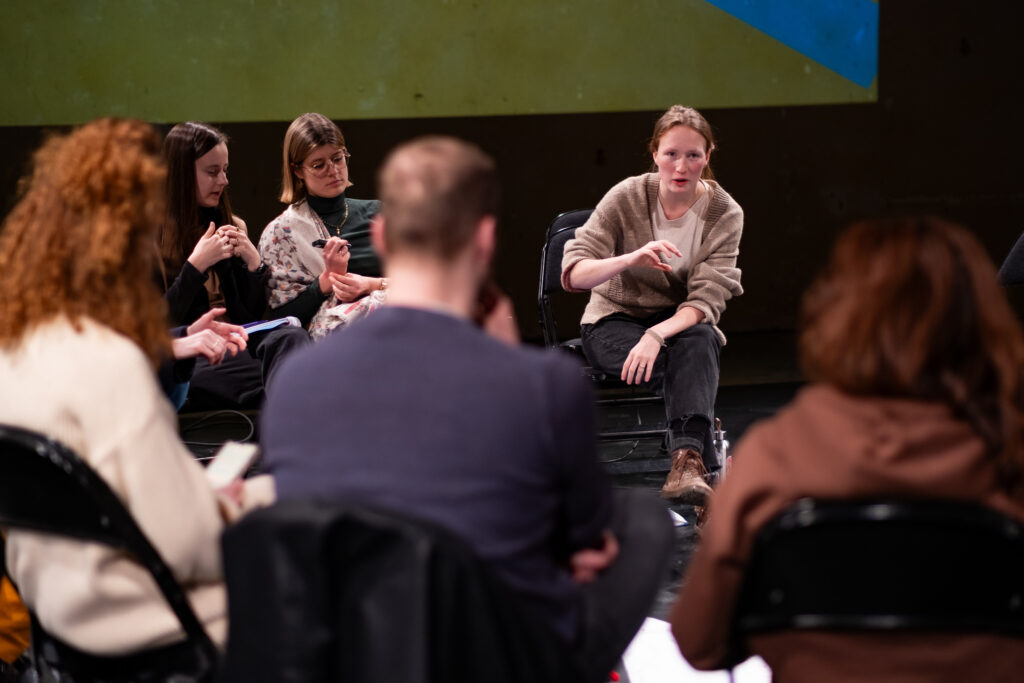
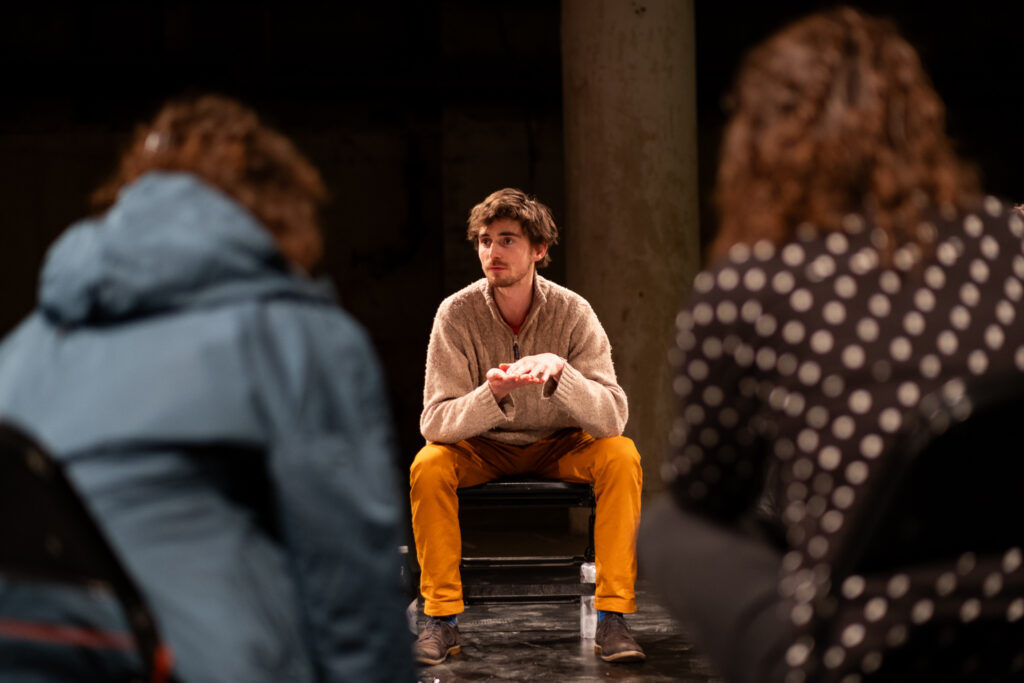
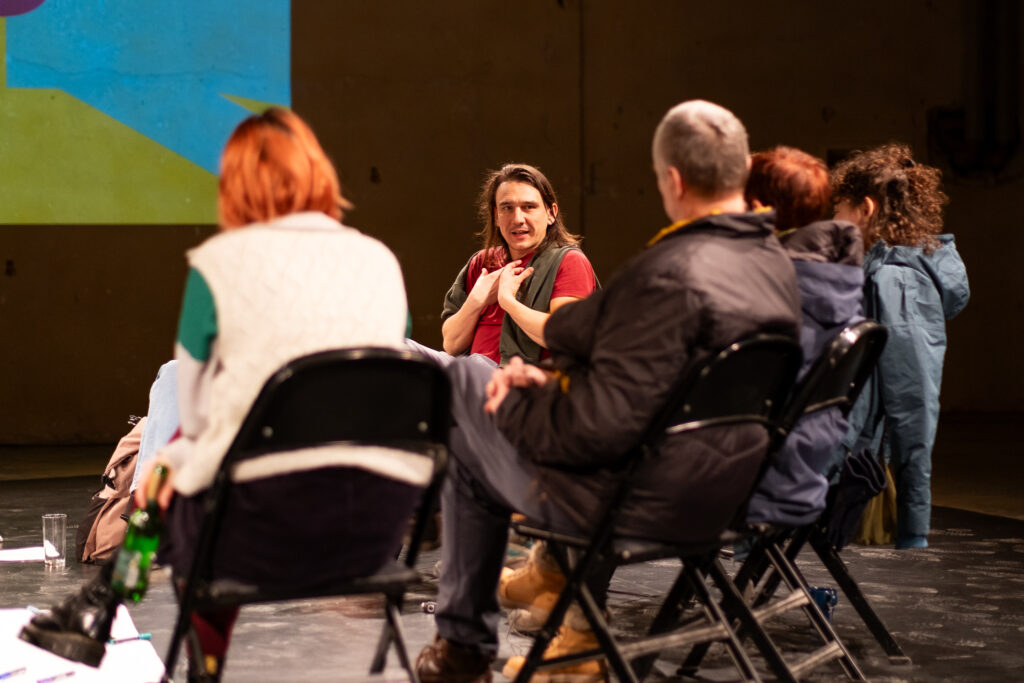
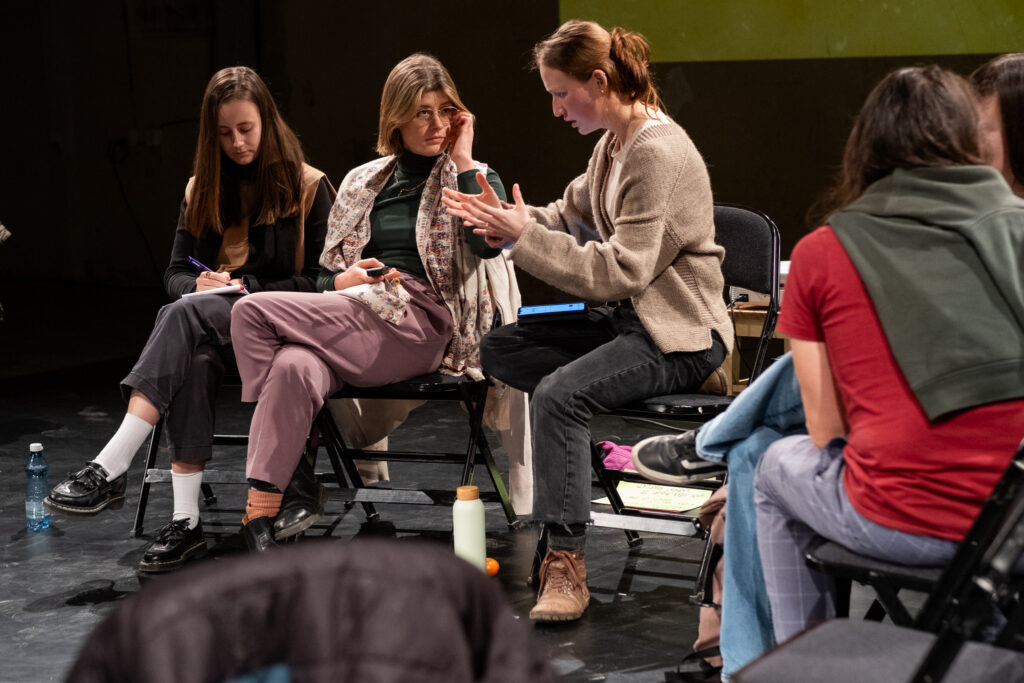
Für eine Kooperationsanfrage des tschechischen Theaterkollektivs tYhle reiste Konflikt- und Dialogforscherin Lilly Roll-Naumann für die Aufführung der Performance (ne)boj am 15. Februar 2025 nach Prag. Dramaturgin Barbora Liška und sie führten gemeinsam einen interaktiven Workshop durch, der Theatergästen die Gelegenheit bot, im Anschluss an die Performance in eine vertiefte Auseinandersetzung mit dem Thema zu gehen. Interaktive, dialogische und reflexive Elemente wurden ergänzt durch einen fachlichen Austausch mit der ConflictA-Forscherin.
Lilly Roll-Naumann und Barbora Liška begannen den Workshop mit einer Aufstellung zu den folgenden Statements zum Thema Konflikt:
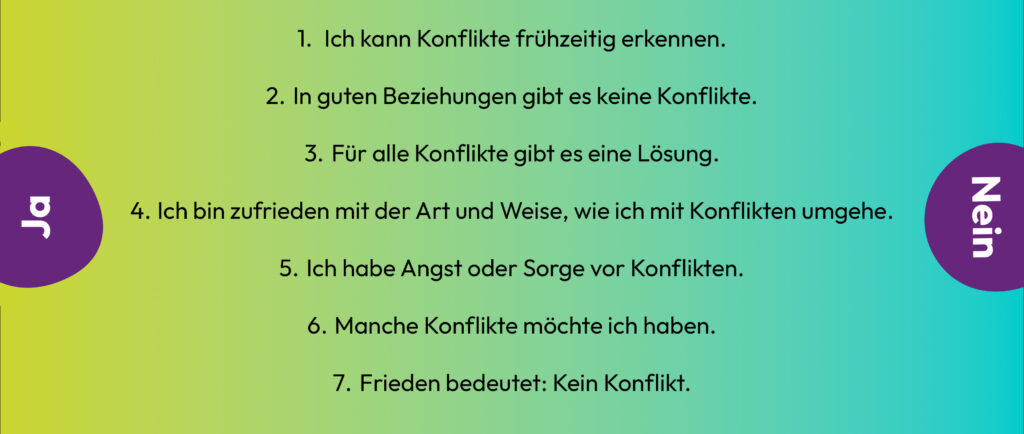
Es zeichnete sich ab, dass die große Mehrheit der Anwesenden Angst oder Sorge vor Konflikten hat, lediglich zwei positionierte sich bei „Nein“. Niemand aus der Runde stimmte der Aussage zu, zufrieden zu sein mit der eigenen Art und Weise, mit Konflikten umzugehen. Die Dolmetscherin scherzte: „Wir haben Arbeit vor uns“.
Einstimmig einig war die Gruppe sich, dass die Aussagen „In guten Beziehungen gibt es keine Konflikte“ und „Frieden bedeutet die Abwesenheit von Konflikt“ nicht zuträfen. Eine Mehrheit stimmte der Aussage „Manche Konflikte möchte ich haben“ zu. So ganz viel Arbeit vielleicht also doch nicht.
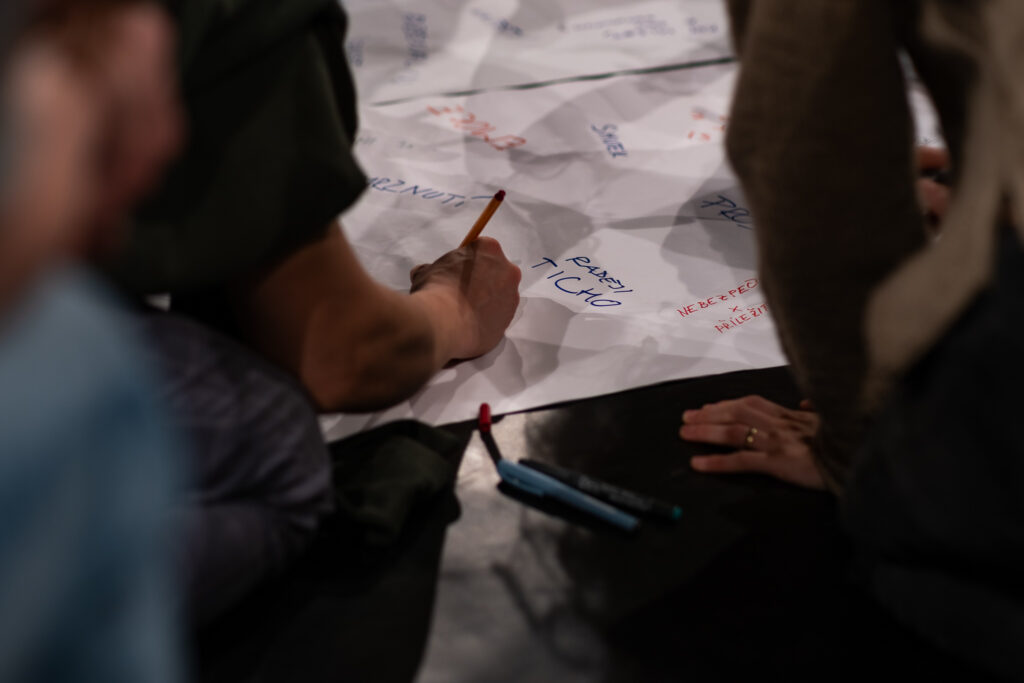
Doch Zustimmungsabfragen sind natürlich begrenzt in ihrer Aussagekraft. Es fehlt ihnen nicht nur an Tiefe, sie lassen auch Raum für Interpretation: Was für eine Person das eine bedeutet, kann für eine andere etwas gänzlich anderes implizieren.Daher ging es beim nächsten Teil im Workshop um das gemeinsame Assoziieren der Gruppe auf einem großen Blatt Papier. Entstanden ist eine „Konflikt-Mind-Map“.
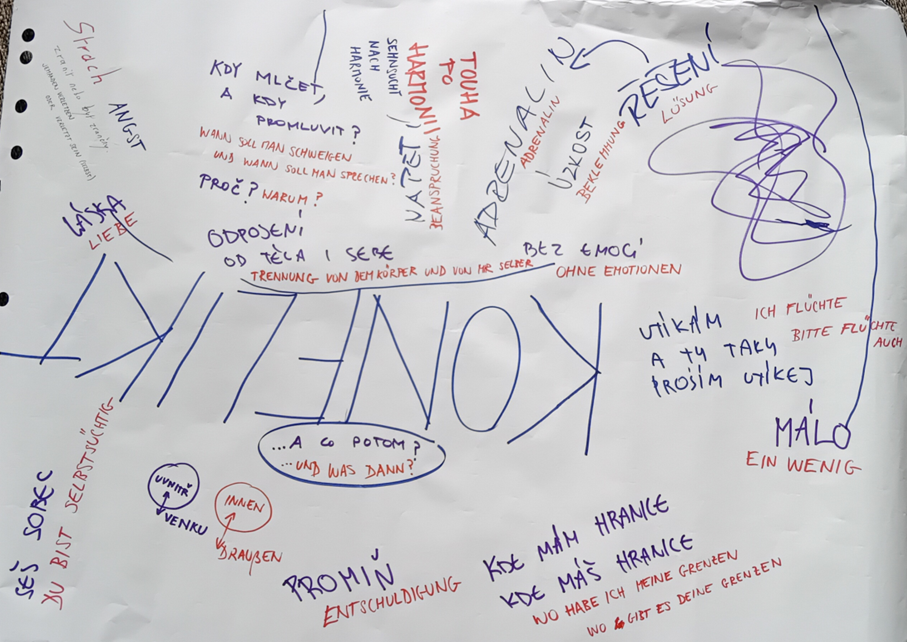
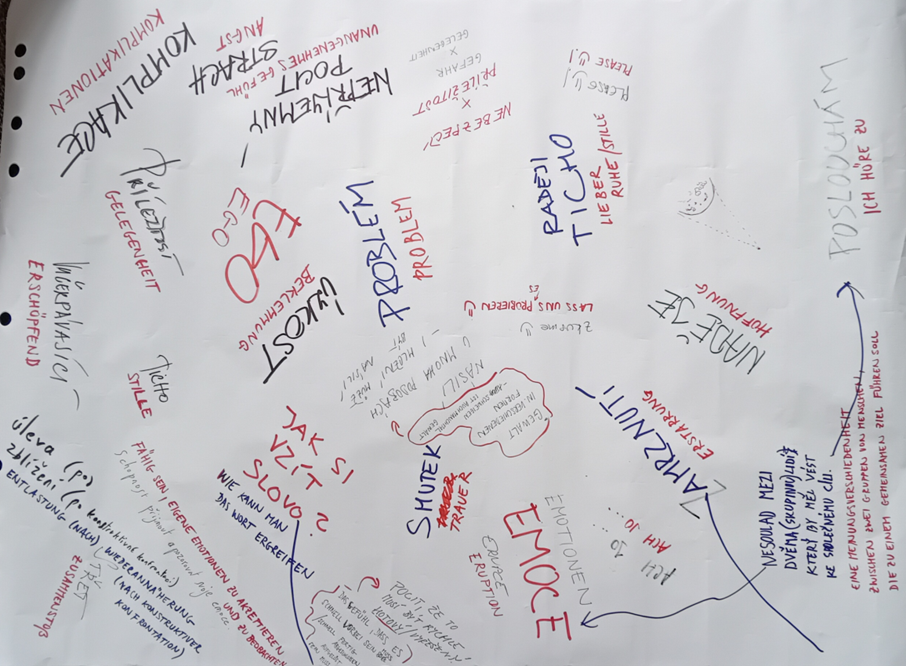
Es fanden sich diese mit Herausforderung assoziierten Assoziationen: „Problem“ • „Ego“ • „Gewalt in verschiedenen Formen“ • „Zusammenstoß“ • „Erstarrung“ • „Beklemmung“ • „Angst“ • „Trauer“ • „Trennung von dem Körper und von mir selber.“ • „Wo sind meine Grenzen. Wo sind deine Grenzen.“ • „Ich flüchte-Bitte flüchte auch-ein wenig“
Daneben fanden sich auch hoffnungsvolle und ressourcenorientierte: „Fähig sein, eigene Emotionen zu akzeptieren und zu beobachten“ • „Ich höre zu“ • „Lass es uns probieren :)“ • „Hoffnung“ und „Liebe“.
Zusammen betrachtet ergab sich ein differenziertes, fast poetisches Gesamtbild.
Wir stellen fest: Konflikt ist kein simples Thema. Vielmehr weckt es eine Gleichzeitigkeit von sehr unterschiedlichen, teils widersprüchlichen Assoziationen, Emotionen, Reflexionen. Selbstverständlich waren ganz unterschiedliche Menschen beteiligt an dieser kollektiven Mindmap. Doch sogar in uns selbst stehen häufig miteinander ringende Gefühle und Gedanken im inneren Konflikt zu dem Thema.
Dieser Ambivalenz wollten wir Raum geben, sie einladen. Wenn Konflikte eines nicht sind, dann schwarz und weiß. Ein Beitrag auf der kollektiven Mindmap fängt exakt dieses ambivalente Potenzial von Konflikt in zwei gegenübergestellten Worten ein:
„Gefahr
x
Chance“
Die Gegenüberstellung zeigt unterschiedliche Betrachtungsmöglichkeiten auf: Wir können Konflikte als Bedrohung, aber auch als normalen Teil menschlicher Beziehungen und gesellschaftlichen Zusammenlebens verstehen. Unsere Einstellung beeinflusst die Art und Weise, wie wir mit Konflikten umgehen. Nehmen wir einen Konflikt als Bedrohung wahr, so vermeiden wir ihn wahrscheinlich oder wappnen uns für einen Kampf. Wenn wir ihn hingegen als normal betrachten, ermöglicht dies uns, den Konflikt selbst und Wege der konstruktiven Bearbeitung offen zu erkunden. Dahinter verbirgt sich die Chance auf Transformation des Status Quo in der Beziehung oder den gesellschaftlichen Zuständen, der den Konflikt überhaupt erst hervorgebracht hat.
Wenn wir uns von der negativen Alltagskonnotation von „Konflikt“ distanzieren und Konflikt als erstmal neutrale allgegenwärtige soziale und gesellschaftliche Realität akzeptieren, wird die Form der Austragung entscheidend: Ist diese gewaltfrei?
Im fachlichen Austauschteil des Workshops tauchten Referentin und Teilnehmende tiefer in das Potenzial sowie die Grenzen von gewaltfreier Konflikttransformation ein.
Neugierig geworden? Dann verfolge hier einen kurzen Exkurs zur gewaltfreien Konflikttransformation: „Exkurs in die Welt der Konflikttransformation„.
In der Abschlussrunde des Prager Workshops gaben uns die Teilnehmer*innen Folgendes mit, bevor die Performer uns mit einer kollektiv durchgeführten Bewegungssequenz aus Ihrem Stück in den Abend entließen:
„Neboj“ (Kein Kampf/Keine Angst),
„Keine Angst im Nebel“
oder
„Empathischer Mut“.
Wie sieht Dein Verhältnis zu Konflikt aus? Finde es im interaktiven Workshop heraus: „Konflikte und ich. Anleitung für einen Kurzworkshop zur Konfliktreflexion“.
In Episode 7 unseres Podcasts „Zankapfel. Konflikte kurz erklärt“ haben wir den Workshop in Prag ebenfalls aufgearbeitet. Hört doch mal rein!
Conflict as an Opportunity? A Workshop Report from Prague
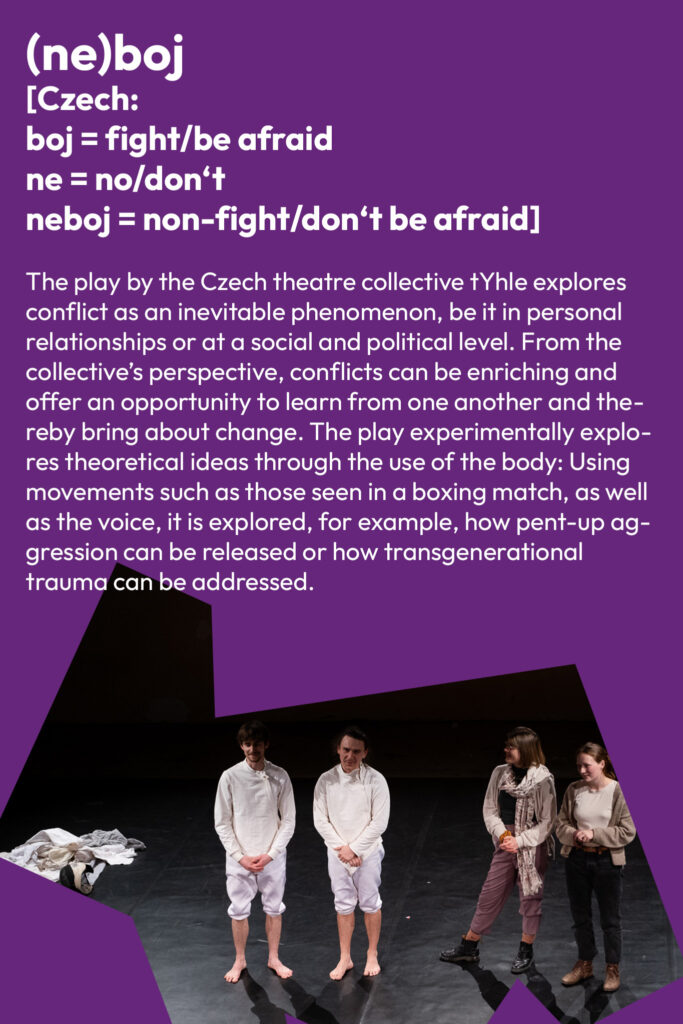
Conflict as an opportunity – to many people, this statement links two phenomena that, at first glance, don’t quite seem to go together. It is precisely this ambiguous complexity of conflict that the performance piece (ne)boj by the Czech theatre collective tYhle explores. At ConflictA, the concept of conflict is also explored from various perspectives – including those of constructive conflict transformation1 and positive peace2, which (re-)define conflict as an opportunity for change.
In response to a collaboration request from the Czech theater collective tYhle, conflict and dialogue researcher Lilly Roll-Naumann travelled to Prague for the performance of (ne)boj on February 15, 2025. Together with dramaturge Barbora Liška, she led an interactive workshop titled ‚Conflict as an Opportunity?‘, offering theatre visitors the chance to engage in a deeper exploration of the topic following the performance. Interactive, dialogic, and reflective elements were complemented by a professional exchange with the ConflictA researcher.
Lilly Roll-Naumann and Barbora Liška began the workshop with a positioning exercise based on the following statements about conflict:
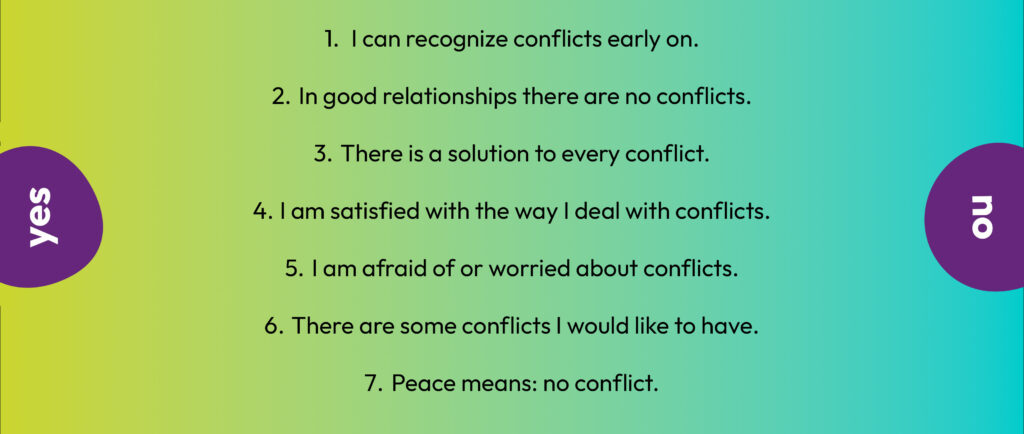
It became clear that the vast majority of those present felt fear or anxiety about conflicts; only two people positioned themselves at “No.” No one in the group agreed with the statement that they were satisfied with their own way of dealing with conflicts. The Czech interpreter joked, “We have a lot of work ahead.”
The group unanimously agreed that the statements “In good relationships there are no conflicts” and “Peace means: no conflict” were not true. A majority agreed with the statement “There are some conflicts I would like to have.” So, not quite as much work at the end.
However, yes/no questions are inherently limited in their significance. Not only do they lack depth, but they also leave room for interpretation: what one person understands by a particular statement may imply something entirely different to another. Therefore, the next step in the workshop involved brainstorming together on the topic of conflict on a large sheet of paper. The result was the following mind map on conflict.
The following associations related to challenges were identified: ‘problem’ • ‘ego’ • ‘violence in different forms’ • ‘collision’ • ‘numbness’ • ‘oppression’ • ‘fear’ • ‘grief’ • ‘separation from my body and from myself’ • ‘Where are my boundaries? Where are your boundaries?’ • ‘I’m running away – please run away too – just a little’
Besides there were also hopeful and resource-oriented responses: ‘Being able to accept and observe one’s own emotions’ • ‘I’m listening’ • ‘Let’s give it a try :)’ • ‘Hope’ and ‘Love’.
Taken together, they painted a nuanced, almost poetic overall picture.
We recognize that conflict is not a simple issue. Rather, it evokes a multitude of very different – and at times contradictory – associations, emotions, and reflections. Of course, a wide variety of people contributed to this collective mind map. Yet, even within ourselves, conflicting feelings and thoughts often struggle against one another regarding this topic.
We wanted to make space for this ambivalence, to invite it in. If there’s one thing conflicts are not, it’s black or white. A contribution to the collective mind map captures precisely this ambivalent potential of conflict in two contrasting words:
‘Danger
x
Opportunity’
This juxtaposition highlights different ways of looking at the issue: We can perceive conflicts as a threat, but also as a normal part of human relationships and social coexistence. Our attitude influences the way we deal with conflicts. If we perceive a conflict as a threat, we are likely to avoid it or brace ourselves for a fight. If, on the other hand, we consider it as normal, this allows us to openly explore the conflict itself and ways of constructively addressing it. Behind this lies the opportunity to transform the status quo of the relationship or the social conditions that caused the conflict in the first place.
If we distance ourselves from the negative everyday connotations of ‘conflict’ and accept conflict as a neutral, ubiquitous social reality, the form of its resolution becomes crucial: Is it non-violent?
During the expert discussion session of the workshop, the instructor and participants delved deeper into the potential as well as the limits of non-violent conflict transformation.
Curious? Then follow a brief excursion into non-violent conflict transformation HERE.
During the closing session of the Prague workshop, the participants shared the following phrases with us before the performers concluded the evening with a collective movement sequence from their piece:
‘Neboj’ (No Struggle/No Fear),
‘No Fear in the Fog’
or
‘Empathetic Courage’.
What is your relation to conflict? Find out in the interactive workshop:
[1] Lederach, J. P. (2003). The Little Book of Conflict Transformation. Intercourse, PA: Good Books.
[2] Galtung, J. (1969).Violence, Peace and Peace Research. Journal of Peace Research, 6(3), 167–191. https://doi.org/10.1177/002234336900600301
Text von/by: Lilly Roll-Naumann