Wenn Konflikte eines nicht sind, dann schwarz und weiß. Das haben auch die Teilnehmer*innen des Workshops „Konflikt als Chance?“ festgestellt. Das ambivalente Potenzial von Konflikt fingen sie in zwei gegenübergestellten Worten ein:
„Gefahr
x
Chance“
Die Gegenüberstellung zeigt unterschiedliche Betrachtungsmöglichkeiten auf: Wir können Konflikte als Bedrohung, aber auch als normalen Teil menschlicher Beziehungen und gesellschaftlichen Zusammenlebens verstehen. Unsere Einstellung beeinflusst die Art und Weise, wie wir mit Konflikten umgehen. Nehmen wir einen Konflikt als Bedrohung wahr, so vermeiden wir ihn wahrscheinlich oder wappnen uns für einen Kampf. Wenn wir ihn hingegen als normal betrachten, ermöglicht dies uns, den Konflikt selbst und Wege der konstruktiven Bearbeitung offen zu erkunden. Dahinter verbirgt sich die Chance auf Transformation des Status Quo in der Beziehung oder den gesellschaftlichen Zuständen, der den Konflikt überhaupt erst hervorgebracht hat.
Wenn wir uns von der negativen Alltagskonnotation von Konflikt distanzieren und Konflikt als erstmal neutrale allgegenwärtige soziale und gesellschaftliche Realität akzeptieren, wird die Form der Austragung entscheidend: Ist diese gewaltfrei?
Gewaltfreie Konflikttransformation ist eng verbunden mit einem Verständnis von Frieden als prozessual, das heißt: Frieden ist darin eine Praxis, ein Vorgang, kein (End)-zustand. Wenn wir Gesellschaft als konflikt-reich begreifen, entscheidet die Form der Austragung darüber, wie friedlich – und demokratisch – eine Gesellschaft, Organisation oder Gruppe ist.
In Abgrenzung zu Konfliktbearbeitungsansätzen wie dem Konfliktmanagement oder der Konfliktlösung, geht der Ansatz der Konflikttransformation davon aus, dass dabei nicht bloß der Konflikt berührt wird, sondern die beteiligten Menschen, Organisationen, Institutionen und Strukturen auch Veränderung erfahren. Somit transformiert der Prozess auch Tieferliegendes und begreift sich als nachhaltiger als schnelle Lösungen. Er verändert im Prozess Menschen und Strukturen und deren Konfliktfähigkeit und -resilienz. Denn Resilienz bedeutet nicht, gewappnet gegen Konflikte zu sein, sondern gut ausgestattet für ihre Bearbeitung. Dies erlaubt es, Konflikt als Chance für notwendigen und zukunftsweisenden Wandel neu zu definieren.
Doch wie kann das aussehen?
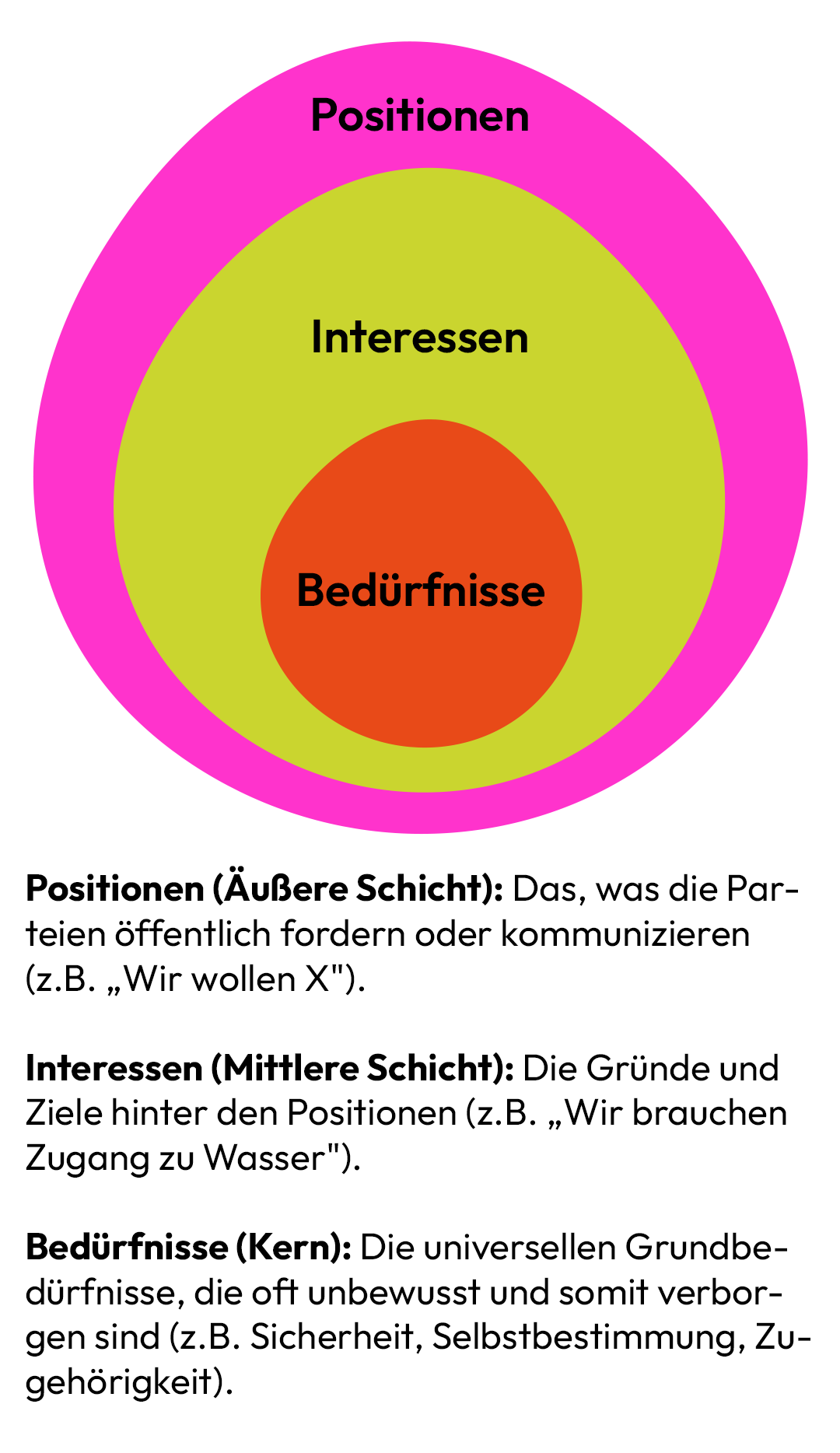
Ein zentraler Grundsatz liegt darin, nach den tieferliegenden Ursachen zu suchen: Was verbirgt sich hinter den Positionen der Konfliktparteien? Das Konfliktzwiebel-Modell verdeutlicht, dass hinter scheinbar unvereinbaren Positionen (äußere Schicht der Zwiebel) Interessen verborgen sind. Die Benennung dieser Interessen (mittlere Schicht) kann uns der Lösung des Konflikts bereits einen Schritt näher bringen. Eine Ebene tiefer liegen die Bedürfnisse (Kern): Was verbirgt sich hinter den erklärten Interessen? Sie zu kennen, eröffnet den Weg für völlig neue, kreative Lösungen. Denn Bedürfnisse können auf viele andere Arten erfüllt werden als durch die ursprünglich geforderten Positionen. Über sie können idealerweise Win-Win-Lösungen gefunden werden, die am Kern des Konflikts ansetzen.
Methoden der praktischen Bearbeitung können freier, moderierter oder methodisch strukturierter Dialog sein, Konfliktmoderation oder Konfliktmediation. Während es bei der Konfliktmoderation und -mediation meist um klassische Lösungsfindung geht, zielt Dialog darauf ab, das Verständnis der Konfliktparteien füreinander zu vertiefen.
Faktoren wie Hierarchie, Beziehung und situative wie strukturelle Machtasymmetrie spielen hier natürlich eine Rolle. Mancher asymmetrischer Konflikt kann daher erst einer Eskalation bedürfen, etwa über Protest oder Streik, damit das Machtverhältnis so verschoben wird, dass die unterlegene Partei überhaupt erst angehört wird. So kann das Ignorieren von Konflikten auch eine Form der Macht- und Gewaltausübung darstellen, die den möglicherweise ungerechten Status Quo aufrechterhält.
Neugierig geworden? Probier die Analyse doch mal bei einem Konflikt aus Deinem Leben aus: Welche Interessen stehen hinter Deiner Position – warum willst oder forderst Du dies? Und welche fundamentalen Bedürfnisse liegen wiederum darunter? Nachdem Du hier Klarheit erlangt hast, kannst Du auch Deinem Gegenüber mit Neugier begegnen und versuchen, tiefer einzutauchen in dessen Erleben, Werte, Wünsche und Bedürfnisse hinter der kommunizierten Position. Beginne am besten mit einem „leichten“ Einstiegsfall und nicht direkt mit einem stark eskalierten Konflikt, der Dich womöglich sehr belastet.
Mehr über Dein Verhältnis zu Konflikten kannst du auch im interaktiven Workshop „Konflikte und ich. Anleitung für einen Kurzworkshop zur Konfliktreflexion“ herausfinden:
Excursion into the World of Conflict Transformation
If there is one thing conflicts are not, it is black or white. The participants of the workshop “Conflict as an Opportunity?” also noted this. They captured the ambivalent potential of conflict in two contrasting words:
‘Danger
x
Opportunity’
This juxtaposition highlights different ways of looking at the issue: We can perceive conflicts as a threat, but also as a normal part of human relationships and social coexistence. Our attitude influences the way we deal with conflicts. If we perceive a conflict as a threat, we are likely to avoid it or brace ourselves for a fight. If, on the other hand, we consider it as normal, this allows us to openly explore the conflict itself and ways of constructively addressing it. Behind this lies the opportunity to transform the status quo of the relationship or the social conditions that caused the conflict in the first place.
If we distance ourselves from the negative everyday connotations of conflict and accept conflict as a neutral and ubiquitous social reality, the form of its resolution becomes crucial: Is it non-violent?
Non-violent conflict transformation is closely linked to an understanding of peace as a process, meaning that peace is a practice, not a final state. If we understand society as inherently rich in conflict, the form of conflict resolution determines how peaceful – and democratic – a society, organisation, or group is.
Unlike approaches such as traditional conflict management, conflict transformation assumes that it does not merely address the conflict itself, but also brings about change in the people, organisations, institutions, and structures involved. Thus, the process transforms deeper-seated issues and is understood to be more sustainable than quick fixes. It changes people and structures trough the process – as well as their conflict management skills and resilience. Resilience does not mean to be braced for conflicts, but rather being well-equipped to address them. This allows conflict to be redefined as an opportunity for necessary and forward-looking change.
But what might that look like?
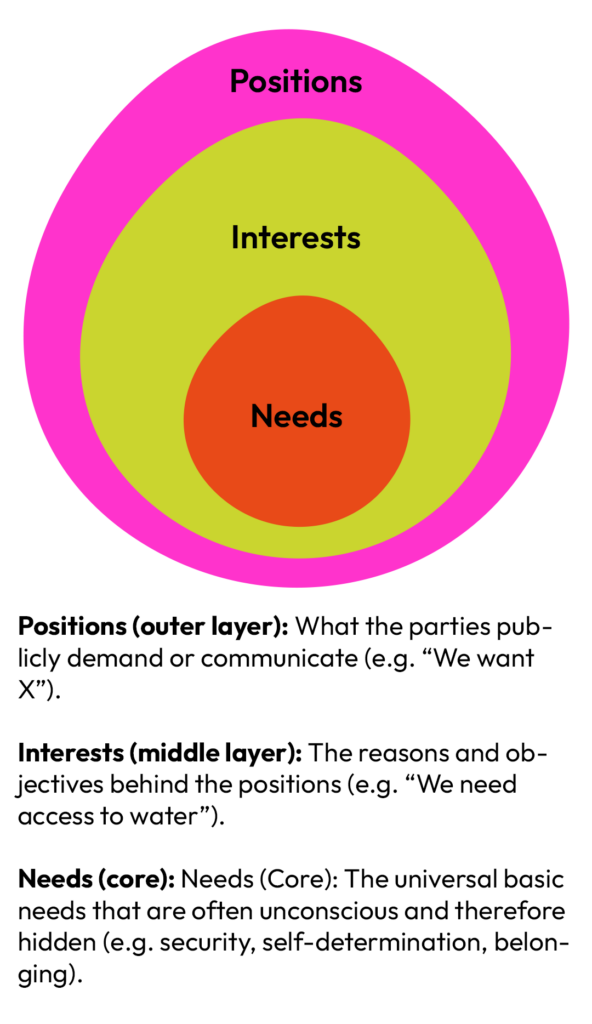
A key principle is to look for the underlying causes: What lies behind the positions of the conflicting parties? The Conflict Onion Model illustrates that interests are hidden behind seemingly irreconcilable positions (the outer layer of the onion). Identifying these interests (the middle layer) can already bring us one step closer to resolving the conflict. One level deeper are the needs (core): What lies behind the stated interests? Understanding them opens the door to entirely new, creative solutions. This is because needs can be met in many ways other than only through the positions originally demanded. Ideally, this can lead to win-win solutions that address the core of the conflict.
Methods of practical resolution may include free, facilitated, or methodically structured dialogue, conflict facilitation, or conflict mediation. While conflict facilitation and mediation typically focus on traditional problem-solving, dialogue aims to deepen the parties’ mutual understanding.
Factors such as hierarchy, relationships, and situational and structural power asymmetries naturally play a role here. Some asymmetrical conflicts may therefore first require an escalation – such as through protest or strike – so that the balance of power shifts enough for the disadvantaged party to be heard at all. Thus, ignoring conflicts can also constitute a form of exercising power and violence that perpetuates a potentially unjust status quo.
Curious? Why not try applying this analysis to a conflict in your own life: What interests underlie your position – why do you want or demand this? And what fundamental needs lie beneath those interests? Once you have gained clarity here, you can also approach the other person in the conflict with curiosity and try to delve deeper into the experiences, values, desires, and needs behind the position they have expressed. It’s best to start with a “simple” introductory case rather than jumping straight into a highly escalated conflict that might be very stressful for you.
You can also learn more about your relationship with conflict in the interactive workshop “Conflict and Me: A Guide to a Short Workshop on Reflecting on Conflict”:
Text von/by: Lilly Roll-Naumann